As I built up my DR 650 for touring over the winter, I imagined this trip would be a voyage of discovery. I would be taking a break from 27-plus years of software engineering, riding the open road with nothing but trees and sky in front of me. No emails, no bug reports, no design diagrams, no meetings, no technical papers, just me and the bike.
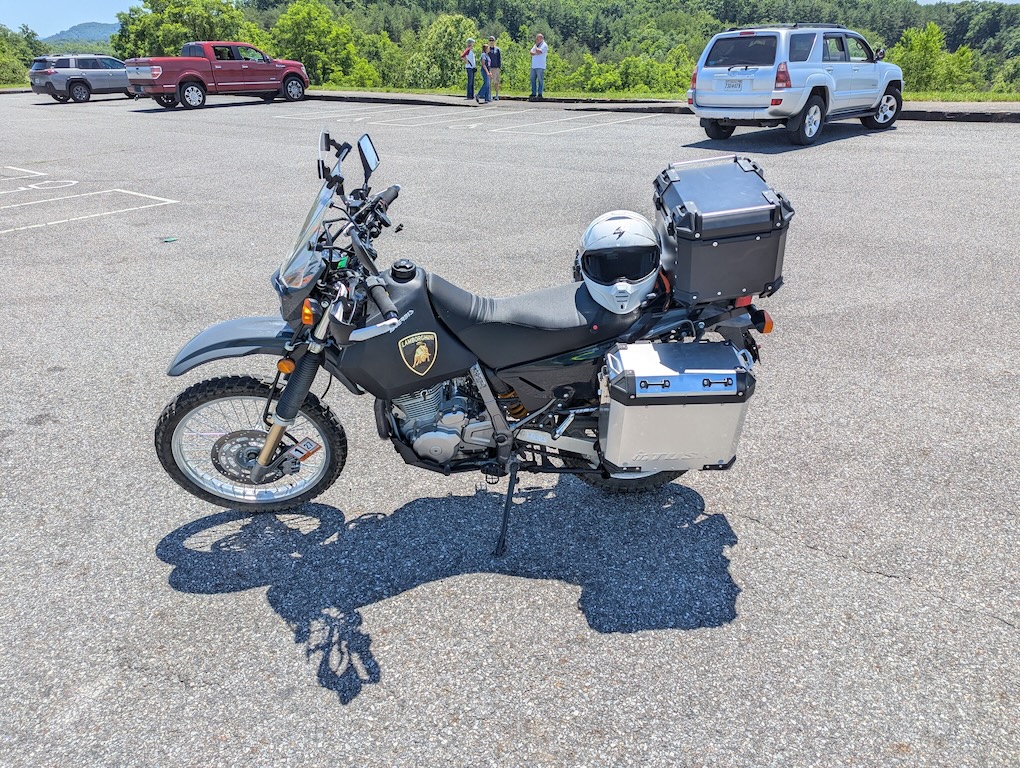
I’ve been thinking for years about getting into another line of work, though I’m not sure which one, and I thought the ride would be a way to cleanse my mental palate. Get rid of all the technical detail that’s been swimming around in there, open up some space for new ideas, and maybe somewhere in the zen of the open country, I would have a revelation.
The plan for day one was to drive from Charlottesville to Bristol, Virginia, sticking mainly to the beautiful Blue Ridge Parkway and then cutting west at some point towards Bristol, which lies on the Virginia-Tennessee border, in the southwest corner of the state. I couldn’t figure out how to plot an exact route on my GPS–or, I should say, I didn’t have the patience to figure it out–so I figured I would ride the Parkway south, following only the road signs, and then turn on the GPS when I was ready to head west to Bristol.
This turned out to be a problem. Once you pass Floyd, Virginia, there is no clean, easy route from the Parkway to Bristol. At least, not one that this stupid GPS cound find. I got onto the Parkway at mile zero, in Afton, and left it at mile 199 near… I don’t know… a clump of trees.
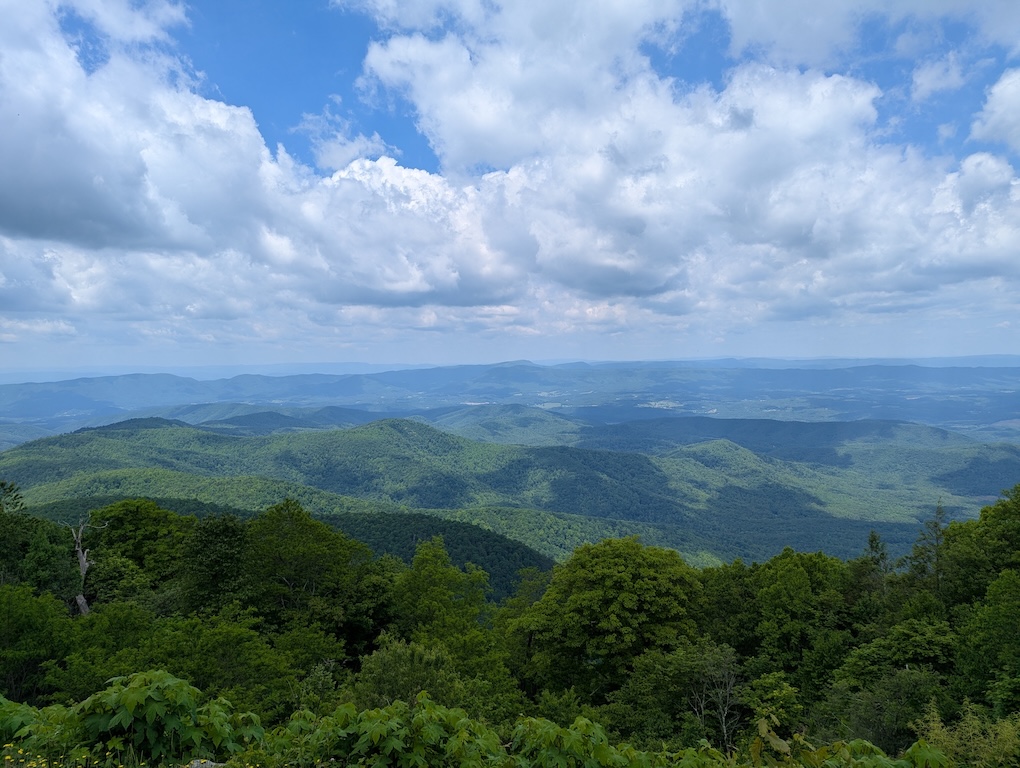
The view from the Arnold Valley overlook on the Blue Ridge Parkway
I plugged in the address of my motel in Bristol and learned, to my surprise, it was much further away than I thought. The GPS wanted me to take Interstate 77 north, then loop back onto 81 south. That seemed stupid. I didn’t want to be on the interstate.
The Garmin Zumo XT2 GPS was designed specifically for motorcycles, and one of its nice features is the “Adventure” setting. If you ask it for basic directions, it will choose the fastest route by default. If you don’t want that route, you can dial up the “Adventure” setting, which will reroute you onto more scenic, motorcycle-friendly roads. I dialed “Adventure” up to five, the GPS gave me a 177-mile route that I absolutely did not want to take. I had already been on the bike long enough.
I had planned to ride no more than six hours per day, and I was now six and a half hours into this ride. My body was hurting. I had just driven a thousand miles from Virginia to Florida in a car, and my back had not yet recovered from that. Six and a half hours on the motorcycle was my limit. But, according to the GPS, I still had almost three hours to go to get to my motel in Bristol. I was not excited about that at all.
But I did it, and I must say, that part of the ride was very unpleasant. Interstates 81 and 77 are both favorites for truckers. You’ll see more big rigs on those roads than on most others. The Suzuki was heavily loaded and I spent the last few hours of that grueling day doing 70+ mph (112+ km/h) with semis in front of, behind, and beside me.
To my surprise, it didn’t take three or four weeks of riding to have my revelation. Before the end of the first day, it hit me loud and clear: I do not want to be riding this bike eight hours a day for the next three weeks.
That wasn’t the revelation I was expecting, but there it was. The main problem was my back, which I’ve had issues with for decades, ever since a spinal injury and corrective surgery.
When I arrived in Bristol, I couldn’t wait to get off the bike. I checked in, carried my bags into the room, and then I took a walk around. I can say two things about Bristol. There’s no good walking by the side of the interstate, and the people are very friendly.
When I woke up on day two, I did a gut check. Do I really want to turn around and head home?
Yup, I’m done.
I really enjoyed the ride back, even though my back hurt like hell. I did about half of the return ride on interstates and half on the Blue Ridge Parkway. I learned a few things about the DR 650 on the way.
- The bike really isn’t bad at all on the interstate, even during long stints. As long as you have a decent windscreen, you’ll be fine. You’d expect a thumper to be buzzy at those speeds, but the DR is pretty smooth. The bike vibrated much less than a V-twin, and the vibrations were never a problem.
- The DR can pass other cars at 70+ mph (112+ km/h) even when it’s heavily loaded. In my case, the rider and gear added up to about 350 pounds (159 kg), and I still had no problem passing big trucks on hills.
- The DR handles well, even when heavily loaded. I got wrapped up with a Harley gang for about sixty miles along the Parkway. None of the Harleys were carrying gear, and without trying to, I kept leaving them behind in the twists.
- The stock Trailwing tires, which have an undeserved bad rap among some riders, are quite good on pavement, but they wore down much more than expected on the Parkway’s unusually rough surface. A few hundred miles of freeway riding under heavy load also contributed to the wear. The tires wore down more in these 700 miles (1125 km) than in the previous 1700 miles (2735 km). Those previous miles were a mix of on- and off-road riding, mostly at speeds under 45 mph (72 km/h).
Lastly, and somewhat concerningly, the petcock on the aftermarket Acerbis gas tank began to leak from the inner valve on the first day of the ride. This part is not available at Suzuki dealers, so I would have to order one online and have it sent to a motel or AirBnB somewhere along my route. Needless to say, having raw fuel drip onto my hot, air-cooled engine made me uneasy. If you search the internet, you’ll find others reporting this same problem with the Acerbis petcock.
Lessons Learned
In the weeks before starting this trip, I was too busy to psychologically prepare for it. I was wrapping up two jobs, helping my son move to another state, helping my daughter get set up with a new apartment in another city, and caring for an ailing dog that I eventually had to put down.
These events wrapped up a few days before I was scheduled to leave. Two days before leaving, I was still working on the bike and had not yet begun to pack, nor had I planned a route. I didn’t really think about the logistics of the trip until six and half hours into the first day of the ride.
I learned something many years ago, when I used to ride ultra long-distance bicycling events: mental preparation is worth at least as much as physical preparation. I learned this one year when I rode 160 miles (257 km) across the Cascades in western Washington. I learned this during my second attempt at a particularly grueling ride. On the first attempt, I was in generally good physical shape, but I was recovering from pneumonia. In fact, I took my last antibiotic as I got on the bike to start the ride. Psychologically, I was absolutely determined to succeed. That determination carried me through.
The following year, I was in better physical shape, but I didn’t give much thought to the challenges of the ride. I was not mentally prepared for the difficulties. Despite being in better physical shape, I struggled the whole way. My body was in the right place, but my mind was not. I discovered that into the ride, and by then it was too late.
I didn’t mentally prepare for this year’s trip either. I would have needed a few weeks for that, but my life was just too busy. Ideally, I would also have done the following differently:
- Choose lighter, soft luggage instead of heavy hard luggage. That weight makes a difference on the long haul.
- Done longer prep rides. I did several three-hour rides on the Suzuki. I should have done a few six- or seven-hour rides. Your body feels much different after six hours on the bike, and you should know how that’s going to feel.
- Don’t start a long ride until my back recovers from the thousand-mile drive I just completed.
Conclusion
So there you have it. The big-adventure-that-wasn’t has now become the world’s shortest travel blog. I’m going to leave these posts up for a while because there are plenty of cool blogs out there about great transcontinental adventures and few or none about abject failures. But I’m sure I’m not the only person this has happened to.
If your big journey didn’t work out, you can read this as a consolation. If you’re still prepping for your adventure, you can read this as a warning to take your preparations more seriously.
So long, and good luck!